Our Animals
Emperor Newt
Tylototriton shanjing
The orange spots on this newt are poison glands. The tips of the ribs push against these glands when a predator grabs them, delivering a small amount of potent poison into the predator's mouth. Wild populations of emperor newts are declining due to habitat destruction and collection for the pet trade. Until 1997, Detroit was the only U.S. Zoo to breed this species. Many of the young have gone to other zoos throughout the country.
Aquatic Caecilian
Typhlonectes natans
Unlike most species of the caecilian, this species has an aquatic lifestyle. They eat invertebrates and fish, and give birth to fully formed young that are miniature versions of the adults. Until recently, aquatic caecilians were illegally imported into the U.S. in great numbers and sold in fish stores under misleading names like 'rubber eels', but they are amphibians, not eels.
Golden Mantella
Mantella aurantiaca
These beautiful frogs are aposematic, which means they use bright, conspicuous colors to let potential predators know that they are toxic. Because of their beautiful coloration, they have become popular in the pet trade. Over-collection and habitat destruction have resulted in drastic reductions in the wild populations, and golden mantellas are now classified as Vulnerable. The Detroit Zoo has been breeding golden mantellas successfully since 1986.
Surinam Toad
Pipa pipa
Although they are called toads, these animals live their entire lives underwater. During breeding, the eggs are pressed into the female's spongy back, where they remain until hatching as tiny, fully formed froglets.
South American Lungfish
Lepidosiren paradoxa
Lungfish live underwater but breathe air at the surface like an amphibian. During the dry season, they burrow into mud and form a cocoon made of shed skin. They can remain encased for years while waiting for rain.
Bullfrog
Rana catesbeiana
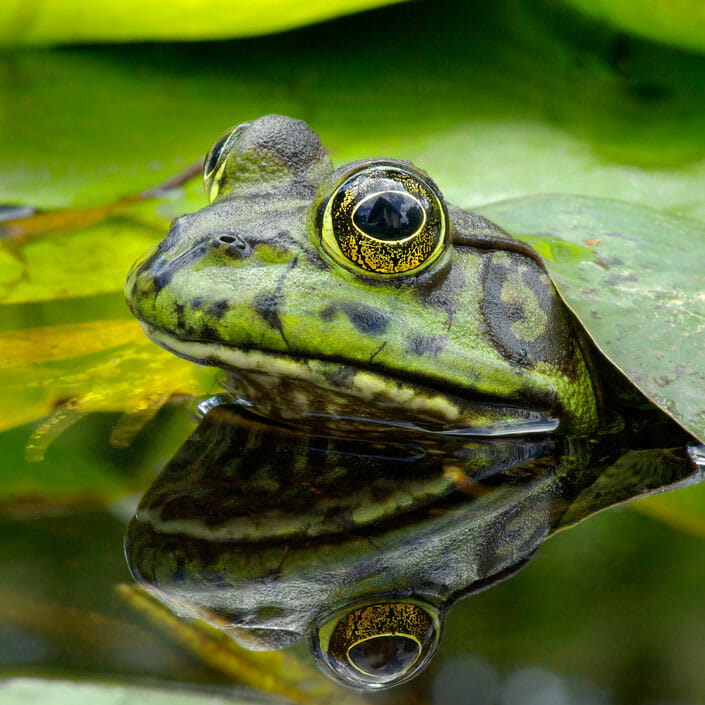
The largest frog in North America, the jug-o-rum call of males can be heard up to half a mile away. Females can lay nearly 50,000 eggs, although few survive to adulthood. Adult bullfrogs can eat small birds, mammals, snakes, and turtles, as well as other frogs. They have been introduced for human food in Hawaii, Jamaica, Mexico, Italy, Japan, and the western U.S., where their voracious appetites are causing the decline of many native animals.
Axolotl
Ambystoma mexicanum
These salamanders spend their entire lives in water. The feathery appendages behind the head are actually gills. They retain this larval characteristic as mature adults, a condition known as paedomorphosis. Wild populations are classified Vulnerable due to pollution and draining of the limited habitat. Salamanders sold in pet stores under the name 'axolotls' are usually larval tiger salamanders, not axolotls.
Mexican Caecilian
Dermophis mexicanus
These bizarre animals are NOT earthworms - they are burrowing amphibians that are rarely seen above ground. They can grow to a length of 18 inches. Females give birth to a dozen or so live young.
Green and Black Dart-poison Frog
Dendrobates auratus
This frog lives primarily on the forest floor. Like other dart-poison frogs, it produces a toxin in its skin that can be highly poisonous to predators. This species has been introduced to Hawaii, and is now considered an invasive exotic.
Vietnamese mossy frog
Theloderma corticale
This unusual Asian frog is a master of camouflage. Its body is covered with bumps and warts that combine with the frog’s cryptic mix of greens, browns and reds to make the frog virtually indistinguishable from a clump of moss. If threatened it will curl into a ball, possibly in an attempt to appear even less like an edible frog.
Japanese Giant Salamander
Andrias japonicus
The second largest salamander in the world, they can grow to over 4½ feet and weigh as much as 88 pounds! Some giants have lived 55 years in captivity. Our animals were captive-bred in 1989 at the Asa Zoo in Hiroshima, Japan, which has produced thousands of young for release into the natural habitat. The primary threat to this Endangered species is habitat loss. It is considered a Japanese National Monument species and receives full legal protection.
Puerto Rican Crested Toad
Peltophryne lemur
Once thought to be extinct in the wild, this Threatened amphibian was rediscovered on Puerto Rico in 1967. Wild populations are still at risk from habitat loss and non-native species (cane toad, mongoose) introduced there by humans. Young of animals bred in zoos have been released among the limestone crevices of their native habitat. Tiny radio transmitter "backpacks" have been placed on some of these toads by researchers to track their movements in the wild.
Hourglass Treefrog
Hyla ebraccata
This attractive little treefrog is common throughout much of Central America. Like many tropical treefrogs, they protect their eggs from aquatic predators by depositing them on leaves above the water. As the tadpoles hatch they wiggle out of the egg mass jelly and drop into the water below.
Panamanian Golden Frog
Atelopus zeteki
Threatened with extinction by habitat destruction, illegal collection for the pet trade, and disease, this Endangered species is bred in captivity and studied in the field by zoo staff (www.projectgoldenfrog.org).
Northern Tomato Frog
Dyscophus antongilii
This colorful frog resembles a plump, ripe tomato. It is considered Vulnerable because it has an extremely limited range and is threatened by habitat destruction and collection for the pet trade.
Painted Mantella
Mantella baroni
Like most Madagascan species, they are threatened by habitat loss. Over 50% of their island-home has been deforested. This is especially tragic considering that 95% of Madagascan species are not found anywhere else.
Mountain Chicken
Leptodactylus fallax
This large and impressive frog whips up its skin secretions into a foam nest near water. The merangue-like nest protects the eggs from predators, overheating, and from drying out. Upon hatching, the tadpoles feed exclusively on unfertilized eggs laid by the attending female. These animals are extremely rare on the island of Montserrat, where much of their habitat was lost to volcanic eruptions and where native islanders hunt them for food.
Golden dart-poison frog
Phyllobates terribilis
This species has the most potent poison drop-for-drop of any animal, 10 times more than the previous record holder, a fish. One frog contains enough poison to kill 20,000 mice or 10 adult humans!
Blue dart poison frog
Dendrobates azureus
Wild populations are isolated in perhaps five 'forest islands' in the savannas of Surinam with no chance for gene flow between populations. This species is part of a managed breeding program among zoos.
Wyoming Toad
Bufo baxteri
This Endangered species underwent a massive population decline and was once considered extinct in the wild. Tadpoles from animals bred in zoos have since been released into the native habitat where the species used to be. The Detroit Zoo participates in efforts to breed and rear this species to ensure against possible extinction.
Mudpuppy
Necturus maculosus maculosus
Mudpuppies, also called waterdogs, have gills throughout life. The size of the gills can indicate the oxygen content of the water. In the warmer parts of their range, the gills are big and bushy. Here in Michigan, the cold water holds more oxygen and the gills are smaller. Mudpuppies also absorb oxygen through their lungs, their skin, and the lining of their mouth. They are often killed by anglers that eroneously believe they are dangerous or detrimental to some fish populations.
Eastern American Toad
Bufo americanus americanus
The common hop-toad of American backyards, this chunky animal eats anything that wiggles and fits in its mouth. They help keep populations of pesty insects under control. Albinos are sometimes found in this region.
Red-spotted Newt
Notophthalmus viridescens viridescens
Members of this genus have a land-dwelling 'teenage' phase called a red eft between the aquatic stages of the larvae and adults. The efts live in the forest for 1-3 years before returning to the water as yellow-green adults.
Gray Treefrog
Hyla chrysoscelis/versicolor complex
These interesting frogs produce a natural antifreeze that protects vital tissues while allowing other areas to freeze. The animals seen here may consist of two similar species that are told apart by their calls.
Eastern Tiger Salamander
Ambystoma tigrinum tigrinum
Reaching over a foot in length, it's one of the largest land-dwelling salamanders. They seem to emerge altogether in early spring and migrate in huge numbers to the breeding ponds, sometimes breeding beneath the ice.
Spotted Salamander
Ambystoma maculatum
These salamanders are also early-spring breeders. Their large jelly-like egg masses often appear green due to the algae growing within them. The algae appear to speed growth and reduce time to hatching.
|